
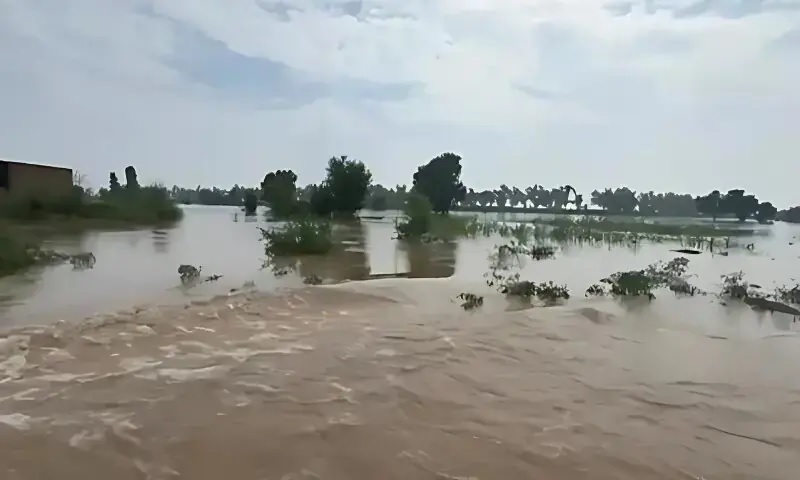
Punjab is dealing with some serious flooding right now. The monsoon rains just won’t let up, and the rivers and drains can’t keep up with all the water. Over the next day or so, both the Ravi and Chenab rivers are expected to rise even more, and that’s got officials worried about several districts.
Right now, roughly 400 square kilometers of land is underwater. Places like Sheikhupura, Muridke, Gujranwala, Narowal, Sambrial and Pasrur are among the hardest hit. Crops are ruined in a lot of spots, animals have been affected, and there’s damage to homes and roads too.
Part of the problem is that the drains just aren’t built for this much water. They’re overflowing in a lot of areas, and in some places, entire roads and fields are sitting under water like a lake.
The Ravi River is a good example of how fast things are changing. Near Shahdara in Lahore, the water flow hit about 22,000 cusecs. Down at Balloki, it shot up to almost 87,000 cusecs. That’s a huge jump, and officials say it’s because of the heavy rain plus all the extra water pouring in from drains.
Nobody’s saying this ends soon, either. Authorities admit it could be several more days before things calm down, and honestly, it all comes down to whether more rain shows up.
As for the rivers themselves — the Chenab is already at medium flood levels in a few spots, while the Ravi’s still holding okay in some areas. But that could change fast. Both rivers might hit medium-to-high flood levels within the next 24 hours.
Officials are watching the Chenab closely at Marala, Khanki and Qadirabad, and keeping an eye on the Ravi at Balloki and Sidhnai too. Basically every major river station right now is under close watch.
Since more rain is expected, several districts have been put on high alert — Lahore, Gujranwala, Sheikhupura, Sialkot, Narowal and Khanewal are all reviewing their emergency plans and beefing up flood monitoring.
Over in Lahore, teams went out to check the Hudiara Drain after the recent downpour. They looked at how the drainage was holding up and tracked where the rainwater was heading.
They also checked other weak points around the city, trying to spot blockages that could make things worse. Officials have now been told to clear out these blockages so water can actually flow through.
In Nankana Sahib, senior officials sat down to go over the flood situation and check how ready they are to respond. They also visited spots where riverbanks have eroded and reviewed their evacuation and rescue plans.
Down in Khanewal, officials checked out the Sidhnai Headworks and a few other flood-protection sites. They looked at the embankments — basically the barriers meant to hold back floodwater — to see how they’d hold up if the rivers keep rising.
For now, the message from authorities is simple: stay alert. The next 24 hours could be critical, and rescue and relief teams are on standby in the areas most at risk.