
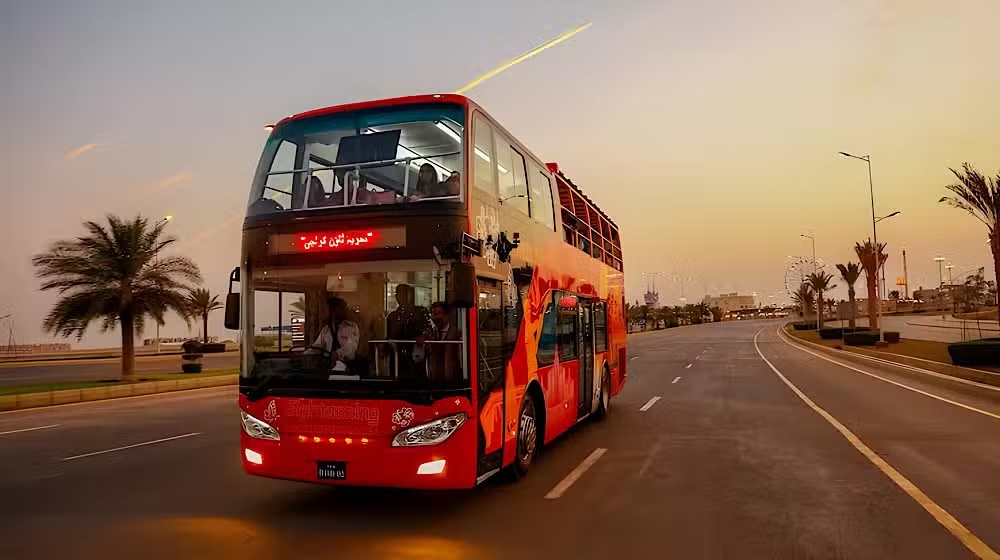
Karachi has witnessed the revival of an iconic mode of transport as double-decker buses return to its roads after nearly five decades. The Sindh government officially launched a trial service on Wednesday, operating from Malir to Sharea Faisal and extending up to Zainab Market.
Inauguration by Sindh Leadership
The service was inaugurated by Senior Minister Sharjeel Inam Memon, along with Local Government Minister Syed Nasir Hussain Shah. Officials briefed the ministers on operational features and facilities provided in the newly introduced buses.
PPP Senator Sherry Rehman’s Daughter Marvi Malik Passes Away at 35
Speaking at the event, Memon stated that the government had fulfilled its commitment to improving public transport in Karachi. He emphasized that more advanced transport options would be introduced in 2026, aiming to enhance commuting across the city.
Expansion Plans Across the City
Memon revealed that, under the directives of Chief Minister Murad Ali Shah, double-decker buses will gradually be deployed on major roads throughout Karachi.
Highlighting the growing demand for public transport, he noted that approximately 100,000 passengers use the People’s Bus Service daily. He also announced plans to expand bus services to all districts of Sindh and disclosed an allocation of Rs900 million for road development in Karachi’s industrial areas. Projects like Shahrah-e-Bhutto were described as key infrastructure initiatives.
Integration of BRT Lines
The minister also shared updates on Karachi’s Bus Rapid Transit (BRT) system, including the merger of the Orange Line with the Green Line. This integration has extended the Orange Line route from four stops to ten, enabling passengers to travel from Orangi Town to Nagan Chowrangi using the Green Line corridor.
According to officials, this move will significantly improve accessibility for residents and streamline urban commuting.
Government’s Vision for Urban Mobility
Chief Minister Murad Ali Shah welcomed the launch, stating that Karachi’s residents deserve efficient and modern travel facilities. He described the initiative as part of a broader vision to transform the city through improved civic services.
“Modern transport reflects urban dignity and better living standards,” he said, expressing optimism about Karachi’s future development.
A Nostalgic Return with Modern Promise
Double-decker buses once symbolized Karachi’s vibrant public transport system during the 1960s and 1970s, especially along routes like Saddar and MA Jinnah Road. Their upper decks were particularly popular among students and young commuters.
However, rapid population growth, increasing traffic congestion, and maintenance challenges led to their gradual disappearance, replaced by minibuses and coaches.
Addressing Karachi’s Transport Challenges
With a population exceeding 25 million, Karachi continues to face severe transport issues, including traffic congestion, inadequate infrastructure, and poor traffic management. Despite initiatives like the Green Line and other transit projects, the city’s mobility challenges persist.
Officials hope that the reintroduction of double-decker buses will not only ease commuting but also revive a cherished aspect of Karachi’s heritage. If the trial run proves successful, more buses will be added to additional routes, contributing to a more efficient and modern public transport system.