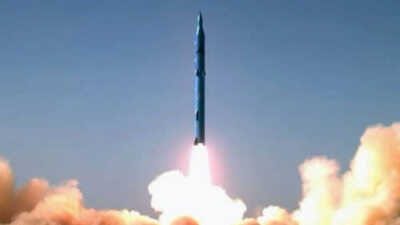
Iran has reportedly launched its Sejjil missile toward Israel for the first time, marking a major development in the region’s military situation.
The Sejjil is an advanced medium-range ballistic missile and is considered an important part of Iran’s defense capabilities. The missile is believed to have a range of about 2,000 to 2,500 kilometers, which is enough to reach Israel from Iranian territory. The distance between the two countries is estimated to be around 1,300 to 1,500 kilometers.

Tensions Rise as Iran Tightens Control Over Key Waterway
Or return to the Homepage
Military experts say that if the missile is launched from Natanz Nuclear Facility, it could reach Tel Aviv in roughly seven minutes, showing its high speed and rapid strike ability.
The Sejjil missile can carry a warhead weighing between 500 and 1,500 kilograms, with about 700 kilograms considered typical. It is designed to carry conventional high-explosive payloads and is also believed to have the potential to carry a nuclear warhead.
According to analysts, this is the first time the missile has reportedly been used in an active military operation. Experts say its speed and ballistic flight path could make it difficult for defense systems, including Israel’s Iron Dome, to intercept.
Middle East Conflict Enters 16th Day
The conflict in the Middle East entered its 16th day on Monday, with hopes for a ceasefire fading after conflicting statements from the United States and Iran about ending the fighting.
Iran’s Foreign Minister Abbas Araghchi rejected claims made by U.S. President Donald Trump that Tehran was seeking a deal to stop the war.
At the same time, many people in Iran fear the continued fighting could cause serious damage to the country. After expanded Israeli strikes, large areas of rubble have been reported in parts of Tehran, while communication networks have been affected due to internet shutdowns.
Iran has also continued launching drone attacks targeting several locations across the Middle East. President Trump said he had contacted seven countries, including China, about protecting the Strait of Hormuz.
In Israel, emergency services reported that the death toll since the beginning of the conflict has reached 15 people. Cluster munitions have reportedly caused damage in parts of Tel Aviv. The Israel Defense Forces said it is expanding its operations against Iran and still has thousands of possible targets under review.
In Lebanon, the health ministry said the death toll has risen to 850 after Israeli strikes in southern areas. Authorities have also issued evacuation orders for several districts of Beirut.
Israel’s foreign minister has ruled out negotiations for now, saying talks are not possible at this stage of the conflict.
Meanwhile, British Prime Minister Keir Starmer spoke with President Trump by phone about efforts to keep the Strait of Hormuz open. Starmer also said he planned to meet Justin Trudeau to discuss the ongoing crisis.
The International Energy Agency said that emergency oil reserves released by the agency could be made available quickly to countries in Asia and Oceania if the conflict continues to affect energy supplies.