
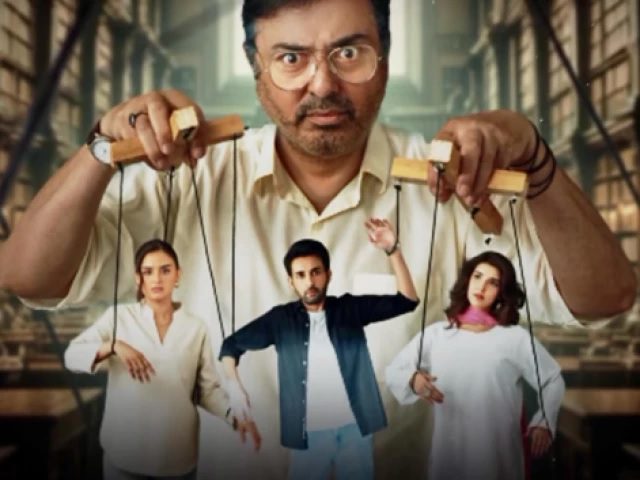
Pakistani dramas have always been good at showing gossip in neighbourhoods. Usually, there is one character — often an auntie — who knows everything, spreads rumours, and influences what people consider “right” or “wrong.” She is the self-appointed guardian of respectability: the gossip queen.
But Sharpasand is different.
In this hit drama, produced by iDream Entertainment for ARY Digital, the role of the gossip-spreader is given to a man — Farasat Ali, played by the legendary actor Nauman Ijaz. This change completely transforms the story.
The title Sharpasand is a play on words: it combines “sharp” and “pasand,” meaning someone who appears agreeable and respectable but is actually cunning and mischievous. Farasat perfectly represents this dual nature.
Disney’s 2025 Live-Action Snow White Reportedly Suffers $170 Million Loss
Nauman Ijaz: Expert in Complex Roles
Nauman Ijaz is famous for playing layered, morally complex characters in Pakistani TV. In Sharpasand, his performance is especially unsettling.
Farasat is not loud. He is not openly evil. He doesn’t storm into scenes to assert dominance. Instead, he whispers, hints, and manipulates.
One striking detail is his sharp gaze and a small twitch near his eye whenever he feels he is losing control. This little tic becomes symbolic: Farasat wants to be socially right, not morally right. If reality does not match his view, he reshapes it.
A Household of Rumours
Farasat, along with his wife Rubina (Nadia Afghan) and daughters Eman and Minahil, forms a domestic network of gossip. Their home becomes a hub where information flows in, gets edited, and flows out — often as a weapon.
Much of their manipulation targets young women in the neighbourhood. They create suspicion between couples, make men doubt their wives, and present Farasat as the voice of reason.
A simple glance becomes proof of an affair.
A slight delay in returning home turns into a scandal.
Shazmeen (Hira Mani), known for playing vulnerable women, suffers the most. Her small actions are twisted and used against her. When Farasat attempts sexual harassment, the story is spun so that Shazmeen looks like the wrongdoer — a widow, independent, and “too modern” for comfort.
Manipulating Relationships
Farasat also targets Sanam (Hareem Farooq) and her husband Fida (Affan Waheed). They are a strong, independent couple.
Instead of confronting Sanam, he manipulates Fida. He befriends him, validates him, and plants seeds of doubt:
- Working late is seen as emotional withdrawal or cheating.
- Fida asserting himself is framed as the full right authority.
- Normal disagreements become “patterns” of misbehaviour.
Farasat doesn’t destroy relationships through open conflict; he erodes them slowly, quietly, and effectively. That is what makes him dangerous.
The Deadly Impact of Gossip
The most tragic story is that of Hafsa, who dies because of gossip. Her story shows how damaging false information can be in close-knit communities. Losing reputation can mean losing protection, support, and a sense of belonging.
Sharpasand does more than show gossip as background noise. It shows it as a powerful force — one that can isolate women, ruin marriages, and even cost lives.
By putting a man at the centre of this gossip network, the drama challenges the usual idea that moral policing is only a “woman’s role.” Here, patriarchy doesn’t shout; it whispers.
The bigger question is not how Farasat’s story ends, but how many such whisper networks already exist around us.