
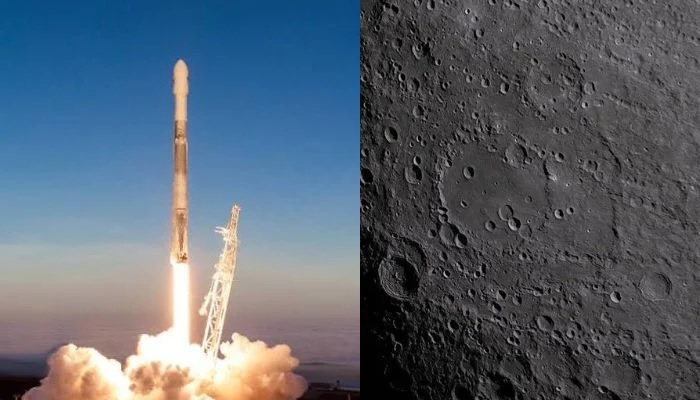
A part of a SpaceX Falcon 9 rocket is expected to hit the Moon on August 5 after drifting through space for several months.
The rocket part was launched in 2025 as part of a joint Japanese and US space mission that aimed to send lunar landers and scientific equipment to the Moon.
According to NASA’s Centre for Near-Earth Object Studies (CNEOS), the rocket’s upper section is expected to crash into the Moon at around 02:35 EDT (06:35 GMT) on Wednesday.
The rocket piece is about the size of a five-storey building and weighs around 4,000 kilograms. It is moving at a speed of about 2.43 kilometers per second, or nearly 5,400 miles per hour.
NASA said the rocket part was accidentally placed on a path that would lead it into the Moon. It is expected to hit an area near the Einstein crater, on the side of the Moon that can be seen from Earth.
Experts say there is no danger to Earth from this impact.
NASA spokesperson Jimi Russell said the agency will continue tracking the rocket part and will study the impact area afterward to learn more about the Moon.
Astronomer Bill Gray, who first identified the rocket’s path, said the crash could create a crater more than 17 meters (56 feet) wide and throw a large cloud of dust up to 50 kilometers into space.
Dr. Matt Bothwell, a public astronomer at the University of Cambridge, said the impact will be a major event on the Moon but is not dangerous.
“It is something very large hitting the Moon,” Bothwell said. “It is not dangerous, and we can simply watch and study it.”
Scientists explain that the impact may look more dramatic than explosions on Earth because the Moon has no atmosphere and has weaker gravity. This means dust and material can spread much higher and farther.
However, people on Earth will not be able to see the crash with their eyes. Telescopes, NASA’s Lunar Reconnaissance Orbiter, South Korea’s Danuri spacecraft, and scientists will observe the event to study the flash, dust cloud, and new crater.
Scientists say the event also highlights the growing problem of space debris. As more satellites and rockets are launched, the amount of human-made material in space continues to increase.
Dr. Bothwell warned that space debris could become a bigger problem in the future because collisions between objects in orbit can create even more dangerous pieces of debris.
The European Space Agency estimates that around 54,000 objects larger than 10 centimeters are currently orbiting Earth. These objects are part of the thousands of tonnes of material sent into space since the beginning of space exploration in 1957.
The Moon impact will give scientists a rare chance to study how objects hit the lunar surface and improve our understanding of impacts in space.